
The Effect of Flight Altitude on Spray Pattern: A Case Study with the L30 V2
In this field test, we evaluated the effect of different flight altitudes on spray pattern and droplet distribution using the ABZ Innovation L30 V2 spraying drone. The objective was to identify how flight altitude influences spray distribution and coverage uniformity under the given test conditions.
Flight Parameters
- Application rate: 20 L/ha
- Flight speed: 8 m/s
- Line spacing: 8 m
- Droplet size: 262 μm
- Flight direction: 176° SSE (South-Southeast).
- Flight altitude: 2 m, 2,5 m, 3 m, 3,5 m.
- Spray liquid: water with biodegradable dye.
Each flight altitude was tested in three repetitions.
Equipment
ABZ Innovation L30 V2 spraying drone equipped for agricultural chemical application. The test was conducted in collaboration with the ABZ Innovation team and ABZ drone pilots.
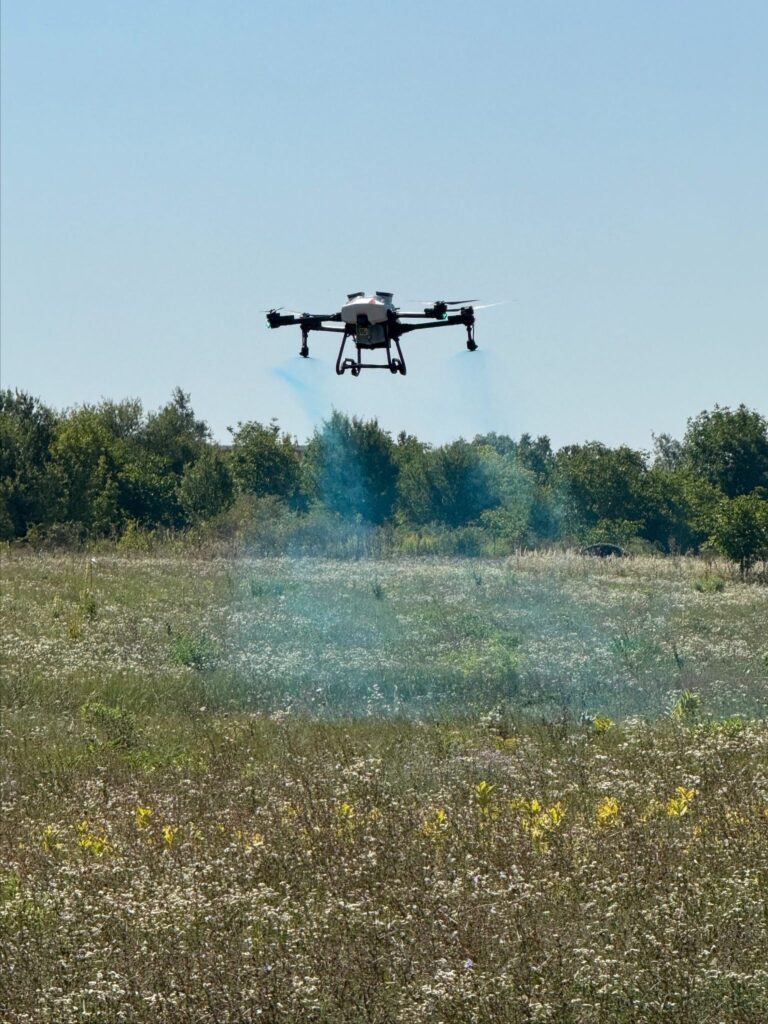
Testing was carried out using only water and biodegradable dye, ensuring zero impact on the environment.
Test conditions
The tests were conducted on the morning of July 17, 2026.
- Temperature: Variable; starting at 30.4°C, dropping to 28.2°C at one point, then rising to 32.5°C by the end of the test series (8:53), reaching up to 33.5°C during Test #11.
- Humidity: Relative humidity was around 45%.
- Wind speed: Ranged between 0.0 m/s and 1.1 m/s during measurements. Although the values were relatively low, when the wind blew, it visibly affected the test results and caused asymmetry in the spray pattern (drift).
- Wind direction: When measurable air movement occurred, the direction varied: 86° ENE (East-Northeast) was recorded during the early morning tests, whereas 266° WSW (West-Southwest) was recorded during later tests.
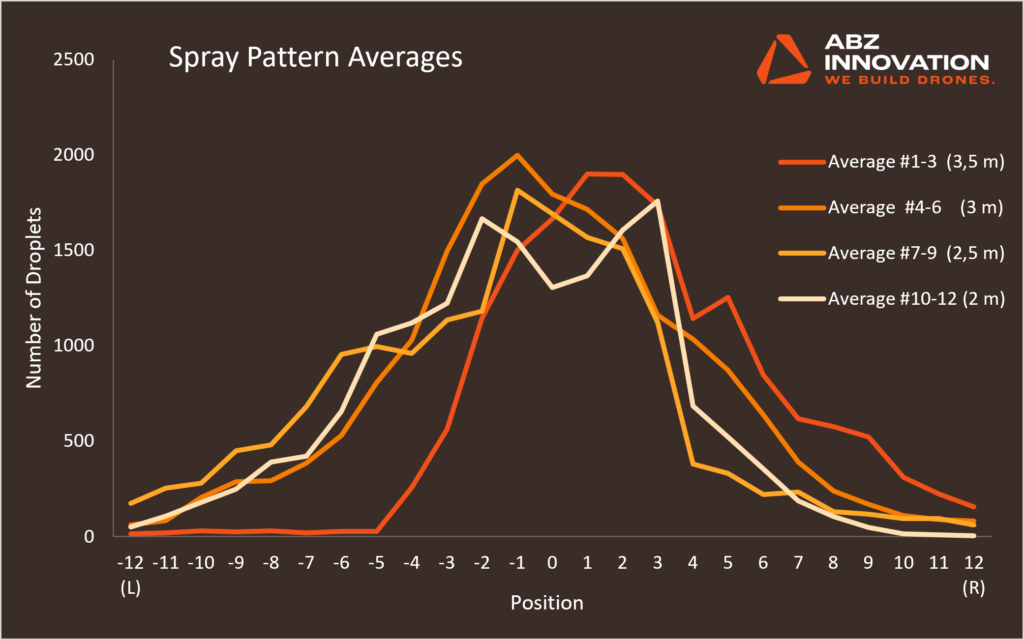
Evaluation: Based on the recorded data, variations observed in the spray patterns and coverage uniformity were clearly and visibly influenced not only by changes in the drone’s flight altitude (3,5 m, 3 m, 2,5 m or 2 m) but also by the wind.
Results
- 3.5-meter altitude (Average #1-3): Demonstrated exceptionally high central efficiency and minimal drift, making it an ideal pattern under completely windless conditions.

- 3.0-meter altitude (Average #4-6): Provided a wide spread with adequate coverage, though requiring caution due to localized high droplet concentrations.

- 2.5-meter altitude (Average #7-9): Offered a gradually spreading, softer overlap across a broader swath width without a defined peak.

- 2.0-meter altitude Average #10-12): Delivered the most balanced and perfectly symmetrical spray pattern, providing an ideal foundation for stripe-free parallel passes.

Key Findings and Advantages
- Optimal 2-Meter Working Altitude: Based on the test results with the L30, a flight altitude of 2 meters delivers the most balanced and symmetrical spray pattern. The slight drop in droplet count directly beneath the drone is perfectly offset by peaks under the nozzles, creating an ideal foundation for stripe-free coverage with overlapping passes.
- Outstanding Drift Control: Thanks to the ground effect and the downward airflow (downwash) generated by the rotors at lower altitudes, droplet counts at the outer positions (-12 and +12) remain close to zero. This guarantees maximum chemical savings and strict adherence to environmental regulations along field borders.
- Heat Resilience and Efficient Target Delivery: During testing, ambient temperatures reached a peak of 33.5 °C. The downward airflow from the L30’s rotors increases droplet velocity, accelerating their journey from the nozzles to the canopy. This increased speed allows droplets to reach the target quickly even in high temperatures, significantly reducing evaporation loss.
- Flexible Field Adaptability: Measurements at various altitudes demonstrate that the spray pattern of the L30 can be finely tuned to match the specific field layouts and topographical conditions of any farm.
Summary
Among the tested configurations, the 2.0 m flight altitude produced the most balanced and symmetrical spray pattern, with a favorable distribution of droplets across the measured swath. The observed distribution suggests that, under the specific conditions of this test, a lower flight altitude can provide a suitable basis for achieving uniform deposition when the selected line spacing and pass-to-pass overlap are properly configured.
The test results also highlight the importance of environmental conditions when evaluating spray distribution. Although wind speeds remained relatively low, measurable air movement was sufficient to influence the symmetry of individual spray patterns. This demonstrates that flight altitude should not be evaluated as an isolated parameter: wind speed and direction, application rate, flight speed, droplet characteristics, rotor downwash, and line spacing all interact to determine the final spray distribution. Overall, the test confirms that precise adjustment of flight altitude can play an important role in optimizing spray distribution with the ABZ Innovation L30 V2.
IMPORTANT NOTICE: This experiment serves strictly as a baseline. In practical commercial applications, spraying configurations, flow rates, and other flight parameters must always be adjusted dynamically to adapt to specific crop vegetation and field layouts, microclimates, and ambient environmental conditions.
Unauthorized reproduction or plagiarism of this work is strictly prohibited. Proper citation is required for any use of its content.


