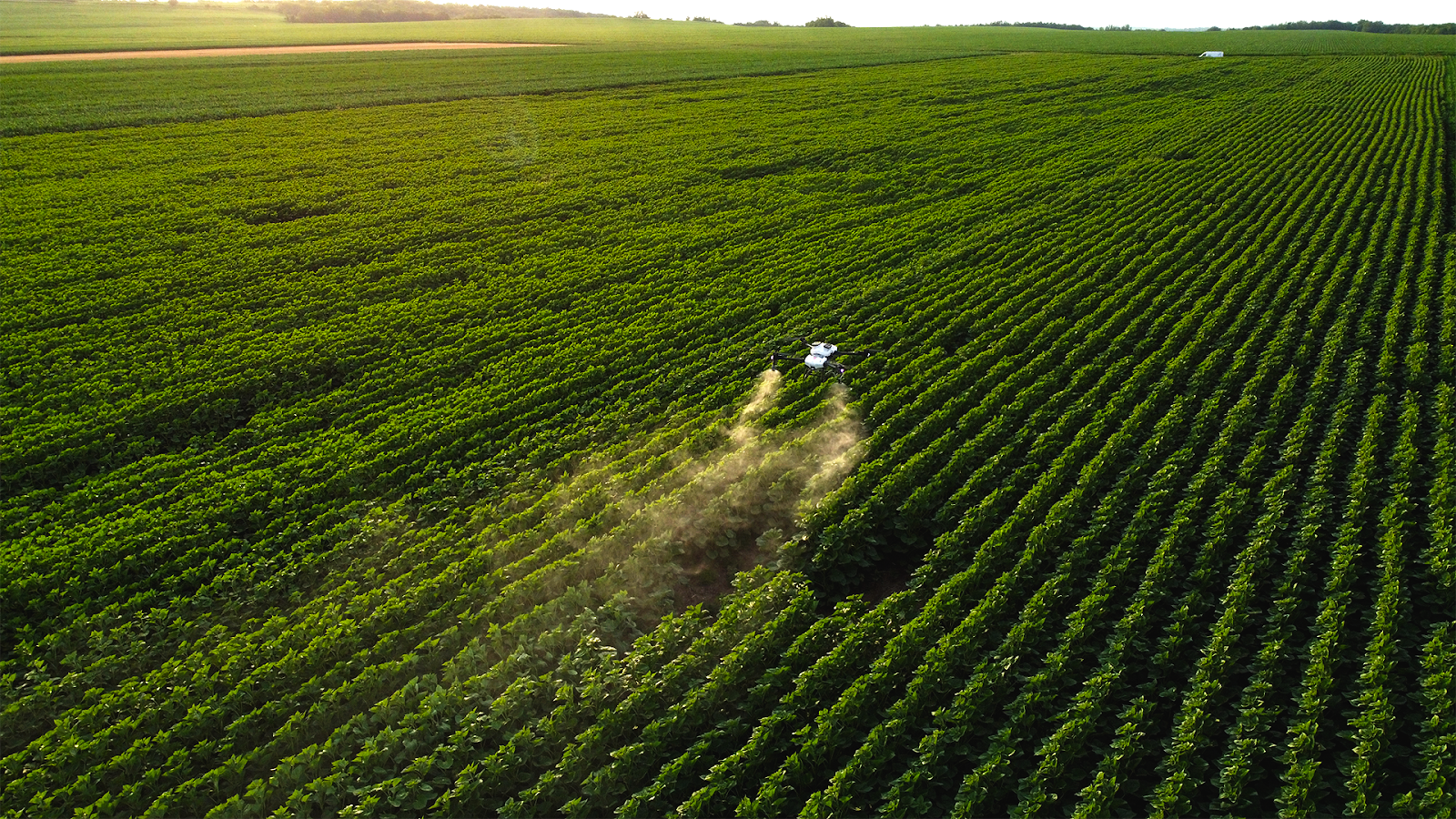
Preparing Crops for Drought: Preventive Treatments and Precision Drone Application
Preparing crops for drought is no longer a luxury; it is the key to survival. Once drought stress has already set in, plants halt their vascular circulation, stomata close, and the efficiency of conventional treatments drops drastically.
The goal of preventive treatments is to prime plant tissues with substances that improve water retention, strengthen cell walls, and activate internal defense mechanisms—well ahead of a heatwave.
Active Ingredients for Drought Priming
Targeted foliar fertilizers and biostimulators applied by spraying drones are absorbed directly through the canopy, providing immediate support.
Foliar Fertilizers and Key Nutrients
- Potassium (K): The “Water Manager”
- Mechanism of Action: Potassium is the primary regulator of turgor pressure responsible for the opening and closing of stomatal pores. With adequate potassium supply, the plant can rapidly close its stomata when ambient humidity drops, preventing excessive transpiration (water loss).
- Calcium (Ca): The Cell Wall Stabilizer
- Mechanism of Action: It strengthens cell walls and cell membranes, allowing cells to better withstand the mechanical and osmotic pressure caused by drought, thereby reducing cell collapse (plasmolysis).
- Silicon (Si): The Mechanical Shield
- Mechanism of Action: It integrates into the cuticle (the outer waxy layer of the leaf), thickening it. This creates a physical barrier that drastically reduces unwanted cuticular water loss. Silicon fertilization improves phosphorus (P) utilization, while organosilicone adjuvants drastically reduce the surface tension of spray solutions (even below 21 milliNewton/meter. Peter J. G. Stevens, 1993)
Biostimulants and Plant Hormones
- Amino Acids (primarily Proline and Glutamic Acid): Proline acts as a natural osmoprotectant. When the plant senses drought, it accumulates proline to increase the solute concentration of the cell sap. This enables the cell to retain water rather than losing it to the drier environment.
- Seaweed Extracts (e.g., Ascophyllum nodosum): They naturally contain betaines, cytokinins, and auxins. They stimulate root system growth (enabling the plant to access water from deeper soil layers) and delay stress-induced premature aging (senescence).
- Abscisic Acid (ABA) and its Precursors: This is the plant’s primary “stress hormone.” By applying it synthetically or stimulating its production, the plant triggers an emergency response: it closes its stomata and redirects energy toward survival before the soil completely dries out.
Why the Spraying Drone is the Perfect Tool for This
When it comes to preventive treatments, timing and precision are everything. Compared to conventional field sprayers, drone application offers insurmountable advantages in this phase:
Timely Intervention
As drought approaches, the ground is often already baked hard, or conversely, a sudden downpour leaves the field muddy just as the forecast predicts an upcoming week of extreme heat. Drone application offers greater flexibility, allowing treatments to be carried out below 25°C or during overcast conditions. Typically, early morning hours are ideal, as both temperature and humidity levels are optimal, and the stomata are still open, which significantly enhances treatment efficacy. Wind is the most critical factor in drone application, so we always operate the drone taking the specific conditions into account and in full compliance with local regulations.
Spot Spraying and Variable Rate Application
Fields are heterogeneous: hilltops and sandier zones dry out much faster than valleys or clay-heavy areas.
- Following a multispectral drone survey, the spraying drone can treat exclusively the vulnerable spots and zones.
- This prevents wasting expensive biostimulants on areas where the soil still retains adequate moisture.
Zero Soil Compaction and Root Protection
Conventional tractor spraying causes a 2–5% yield loss due to trampling and compaction. Under drought conditions, this is exacerbated: the soil in the compacted tire tracks dries out completely, and the root systems of the damaged, stressed plants perish. The drone operates contact-free, preserving both canopy integrity and soil structure.
Drastic Resource Savings
- Water Savings: While conventional machinery operates with 200–300 L/ha of water (in case of treating arable crops), drones utilizing Ultra-Low Volume (ULV) technology can cover the field with just 10–30 L/ha. During drought periods, water itself is a valuable resource; minimizing its use for spraying is critical.
- Energy and Cost: Drones run on batteries, which costs a fraction of the diesel consumed by high-horsepower tractors. This reduces logistical costs (no need to haul thousands of liters of water to the edge of the field) and minimizes trampling-related yield losses.
In Summary: Proactive Defense Meets Precision
Preventive treatment acts like a vaccine: crops must be fortified with essential nutrients before drought stress sets in. To execute this with millimeter precision, the ABZ Innovation L-Series spraying drones provide a purpose-built solution. Leveraging Ultra-Low Volume (ULV) technology, they ensure these critical treatments are applied flawlessly through:
- Controlled Droplet Application (CDA): Adjustable droplet sizing ensures biostimulants and fertilizers adhere directly to the canopy, minimizing drift and maximizing absorption.
- Optimal Timing: High-capacity tanks and efficient batteries enable rapid field coverage during narrow, ideal application windows (such as early mornings).
- Reliable Ecosystem: Beyond the hardware, the L-Series offers a complete package including operational safety, regulatory compliance, and dedicated technical support.