
Evaluating the Efficiency of the ABZ Innovation L30 V2 with Spreader System
Drone-Based Cover Cropping
1. Introduction & Background
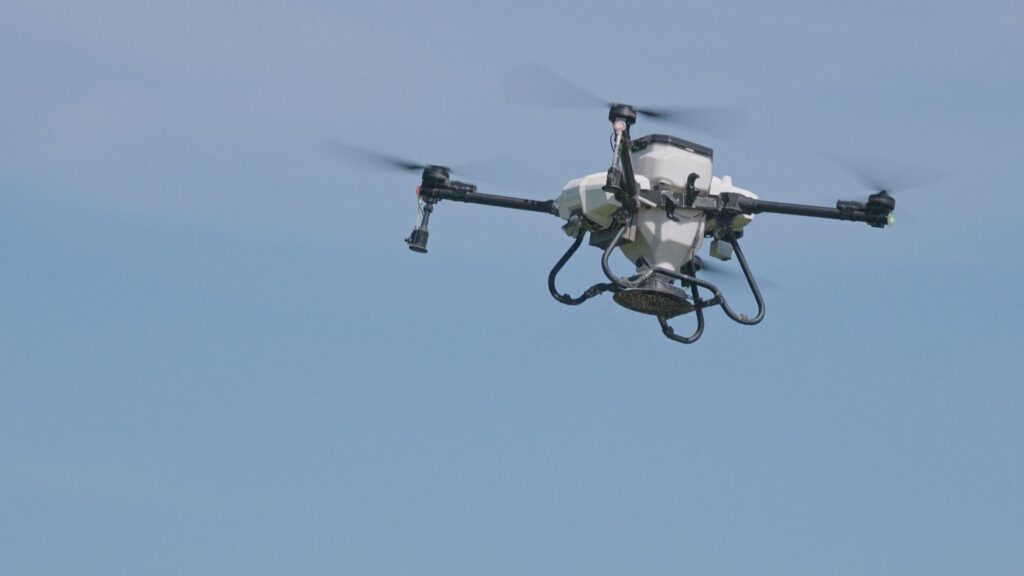
As modern agriculture transitions toward regenerative practices, establishing cover crops has become essential for soil health and resource optimization. However, traditional seeding methods often cause mechanical damage to standing primary crops. This report evaluates how the ABZ Innovation L30 V2 drone overcomes this logistical bottleneck, providing an efficient, zero-ground-compaction alternative for precision interseeding.
2. Executive Summary
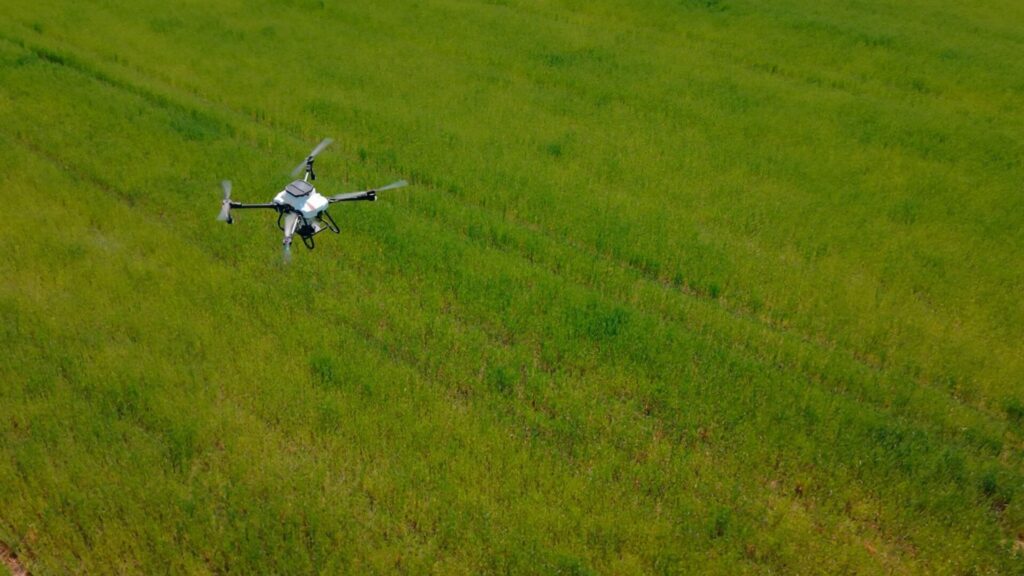
This technical use case evaluates the operational efficacy of the ABZ Innovation L30 V2 drone equipped with a 50-liter spreader system for overseeding cover crops directly into a standing cereal crop. Conducted on May 20th, the trial demonstrated a critical technological milestone: successful broadcast seeding across multiple seed sizes—ranging from small grains to large legumes—without causing mechanical damage to the primary crop. This method overcomes traditional machinery limitations, providing a highly scalable, weather-independent solution for modern regenerative agriculture.
3. Agronomic Context & Technological Challenge
Establishing cover crops (green manure) post-harvest is an established agrotechnical best practice. Cover cropping provides vital physiological benefits to soil ecology, including moisture retention via soil canopy coverage, substantial reduction in water and wind erosion on sloped terrains, and enhancement of organic matter. Furthermore, integrating leguminous varieties facilitates natural atmospheric nitrogen fixation, decreasing synthetic fertilizer dependency. The root systems physically aerate the soil structure, while early dense coverage effectively suppresses weed germination.
The Traditional Limitation: Standard cover cropping requires the primary crop to be harvested first, or relies on high-clearance ground rigs that inevitably trample and damage the standing crop. Drone-based delivery decouples seeding from ground conditions, enabling seamless under-sowing or interseeding into mature, standing canopies.
4. Trial Details & Operational Setup
The field trial was executed to evaluate the payload and distribution capabilities of the platform in a real-world scenario.
Table 1: Trial Specifications
| Paramètres | Specification |
|---|---|
| System Tested | ABZ Innovation L30 V2 Platform |
| Payload | 50L Granule & Seed Spreader System |
| Trial Date and Location | May 20, 2026, Hungary, Tinnye |
| Target Environment | Standing wheat crop |
| Application Type | Interseeding / Cover Cropping |
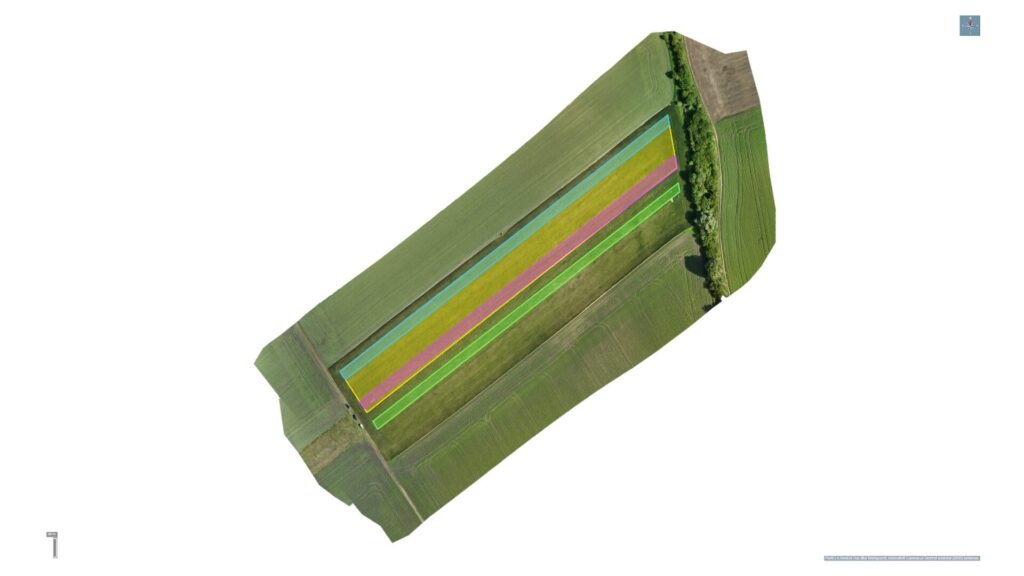
Orthomosaic map of the experimental cover crop trial layout
Methodology & Calibration Profile: The large capacity 50L spreader system allowed the flight crew to handle high-volume distributions efficiently. Seeding operations were carried out over designated sub-plots, allocating approximately 0.5 hectares of treated area per seed type.
To ensure optimal inter-row penetration within the standing cereal crop, the flight parameters were systematically calibrated for uniform volumetric distribution within the crop matrix rather than pinpoint precision spacing. While this specific field trial was performed using manual calibration, it is important to note that automatic calibration features are now fully available on the platform. Precise calibration remains a fundamental requirement to guarantee a uniform flow rate across varying seed dimensions, ensuring that the actual volumetric output per hectare strictly matches the pre-planned agronomic targets.
Table 2: Flight Configuration Parameters
| Flight Parameter | Operational Value | Strategic Objective |
|---|---|---|
| Flight Altitude | 5.0 meters | Optimizes downwash penetration into the standing canopy |
| Effective Swath Width | 4.0 meters | Ensures stable, high-density distribution across rows |
| Ground Speed | 6.0 m/s | Balances operational efficiency with volumetric discharge consistency |
| Area Treated Per Variety | ~0.5 ha | Validates statistical consistency of mass flow rate |
5. Seed Variety Evaluation & Application Metrics
A critical objective of this trial was verifying the versatility of the spreader system across vastly distinct seed geometries, weights, and application volumes. The ABZ Drone Ltd. pilots successfully calibrated and deployed four distinct profiles.
Table 3: Seed Application Rates
| Seed Variety | Application Rate | Operational Notes |
|---|---|---|
| Crimson Clover | 30 kg/ha | Excellent: Small, lightweight seed; uniform distribution. |
| Millet | 30 kg/ha | Excellent: Medium, dense seed; highly consistent flow rate. |
| Faba Bean | 90 kg/ha | Successful: Exceptionally large, heavy seed; proved high torque capacity without clogging. |
| Green Manure Mix | 10 kg/ha | Successful: Multi-species blend; handled varied seed densities simultaneously without segregation. |
Multi-Species Green Manure Mix Composition
The tested Green Manure Mix consisted of a highly diversified, agronomically optimized blend designed to enrich the soil profile across multiple layers. The mechanical spreader successfully distributed the heterogeneous mixture containing the following varieties:
- Legumes (Nitrogen Fixation & Deep Rooting): Crimson clover, Alexandrian clover Chickling vetch.
- Grains & Forage Grasses (Biomass & Structure): Rye, Sorghum, Sudangrass hybrid.
- Soil Conditioners & Pollinator Friendly Species: Flax / Linseed, Lacy phacelia.
Key Finding: While small, low-light-demanding seeds that germinate shallowly are agronomically ideal for drone overseeding, the successful delivery of Faba Beans proves that the ABZ L30 V2 spreader mechanism possesses the mechanical capability and torque required to meter and broadcast large-diameter seed varieties seamlessly without clogging or fracturing the seed coat.
6. Agronomic Best Practices: Meteorological Timing
To maximize germination success, seeding operations must be precisely timed within 24 to 72 hours before forecasted rainfall. Because drone broadcasting deposits seeds directly onto the soil surface, immediate precipitation is critical to provide the necessary moisture for rapid hydration and germination, completely eliminating the need for mechanical tillage or soil incorporation.
7. Conclusion
The ABZ Innovation L30 V2, equipped with the 50L spreader system, has proven to be a highly effective tool for advanced cover cropping operations. By successfully broadcasting a diverse spectrum of seed sizes—including complex multi-species mixes and heavy legumes—into standing crops without yield-reducing mechanical damage, this technology presents a vital operational advantage for large-scale agricultural enterprises aiming to improve soil health, meet environmental compliance targets, and optimize input costs.
Flight operation team: ABZ Drone Ltd.
IMPORTANT NOTICE: This field evaluation represents a preliminary, exploratory trial. Further scientific investigations, rigorous replication trials, and continuous software testing are required to unlock even higher levels of precision and maximize overall operational efficiency.
This experiment serves strictly as a baseline. In practical commercial applications, system configurations, flow rates, and spinner parameters must always be adjusted dynamically to adapt to specific field layouts, microclimates, unique seed geometries, and ambient environmental conditions.


