
4.0 Données de performance et dynamique de la bande de travail
A key feature of the ABZ Innovation L10 and L30’s advanced flightcontrol system is the automatic flow rate adjustment. The pilot sets a target application rate (e.g., Liters per Hectare or Gallons per Acre) before the mission. During flight, the system continuously monitors the drone’s ground speed and automatically adjusts the liquid flow from the CDA system to maintain this precise rate. This ensures a consistent and even application across the entire field, even as the drone accelerates, decelerates, or navigates turns. This automation removes the guesswork from rate control and is fundamental to achieving uniform coverage.
4.1 ABZ Innovation L10:
Swath Profile vs. Flight Heigh
Les graphiques suivants illustrent le profil de dépôt de pulvérisation du L10 en pourcentage de la couverture moyenne sur toute la largeur de travail. Une ligne droite indique une meilleure uniformité (un coefficient de variation plus faible).
Graphique 4.1.1 : L10 à une hauteur de 2 mètres
Effective Swath: 4.5 meters
Pattern: Highly concentrated with a peak of ~140% of the average rate at the center.
Best Use: Targeted application where high concentration is needed.
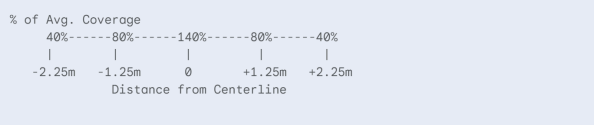
Graphique 4.1.2 : L10 à une hauteur de 3 mètres
Effective Swath: 5.0 meters
Pattern: More balanced, with a less pronounced central peak (~120%).
- Utilisation optimale : Usage général, bon équilibre entre couverture et pénétration.
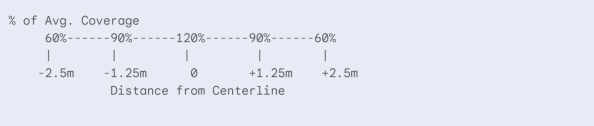
Graphique 4.1.3 : L10 à une hauteur de 4 mètres
Effective Swath: 5.5 meters
Pattern: Wide and uniform, with most of the swath near the 100% average.
Best Use: Field crops, maximizing coverage with overlap.

Graphique 4.1.4 : L10 à une hauteur de 5 mètres
Effective Swath: 6.0 meters
Pattern: Broadest and most even, designed for overlapping passes.
Best Use: Maximum efficiency on large, open fields (e.g., pasture, cereals).

4.2 ABZ Innovation L30: Swath Profile vs. Flight Heigh
Le L30, plus grand, présente une relation similaire entre la hauteur et l'uniformité, mais sur une bande plus large.
Graphique 4.2.1 : L30 à une hauteur de 3 mètres
Effective Swath: 7.0 meters
Pattern: Concentrated for a wide drone like the L30, with a peak of ~125%.
Best Use: High-volume applications on row crops or orchards.
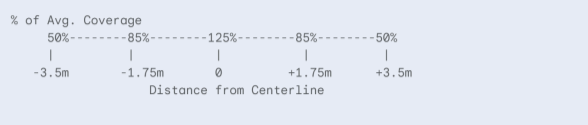
Graphique 4.2.2 : L30 à une hauteur de 4 mètres
Effective Swath: 8.0 meters
Pattern: Excellent uniformity, with a wide, flat deposition pattern.
Best Use: The standard for broadacre crops like corn and soybeans.
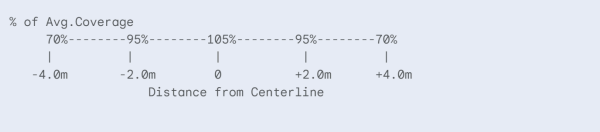
Graphique 4.2.3 : L30 à une hauteur de 5 mètres
Effective Swath: 9.0 meters
Pattern: Extremely wide and uniform, designed for maximum productivity.
Best Use: Large-scale preventative treatments where efficiency is paramount.
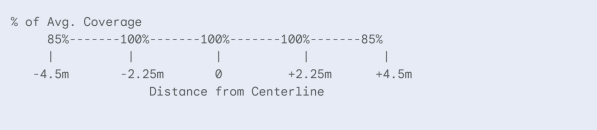
4.3 Adjusting Flight Speed for Spray Pattern Refinement
Bien que le système intelligent des modèles L10 et L30 ajuste automatiquement le débit afin de maintenir le taux d'application cible (L/ha) quelle que soit la vitesse, la vitesse du vent joue toujours un rôle crucial dans la définition de la forme du jet et son interaction avec les cultures.
Faster Speed for Enhanced Uniformity: As the drone moves faster, the surrounding airflow interacts more dynamically with the spray droplets. This can create a “feathering” effect at the edges of the spray swath, resulting in a softer, more gradual taper. This effect can lead to an even more seamless blend between overlapping passes, further enhancing field-level uniformity, especially when flying at higher altitudes for maximum efficiency.
Slower Speed for Canopy Penetration: A slower speed allows the powerful downwash from the rotors to have a more direct and prolonged impact on the crop canopy below. This focused energy is ideal for driving droplets deep into dense canopies, ensuring the product reaches lower leaves and stems where pests and diseases may hide.
Operators can therefore use speed as a final tool for refinement: use a faster speed to achieve the highest level of uniformity on open field crops, and a slower speed when maximum canopy penetration is the primary goal.
4.4 Obtenir une couverture uniforme du terrain avec chevauchement
The key to achieving true field-level uniformity is the precise overlapping of each spray pass. As the charts above show, the deposition rate naturally tapers off at the edges of a single swath. By setting the correct swath width in the flight planning software, the system ensures that the tapered edge of one pass is perfectly compensated by the tapered edge of the adjacent pass. This technique smooths out the minor variations from each individual line, resulting in a highly consistent application across the entire field.
Chart 4.4.1: Uniform Field Coverage Through Overlapping Swaths
Ce graphique illustre comment les bords effilés de deux passages de pulvérisation adjacents se combinent pour créer une application homogène et uniforme. L'objectif est que la somme de la couverture dans la zone de chevauchement soit égale au taux cible (100 %).
Exemple utilisant un profil simplifié à passage unique :
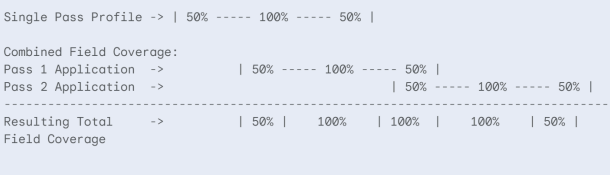
Result: The dip in coverage at the edge of Pass 1 (down to 50%) is perfectly filled by the start of Pass 2 (which provides the other 50%), resulting in a continuous, even application at the target rate (100%) across the entire field.
5.0 Conclusion
The effective and responsible application of agricultural products is dependent on the precise control of operational parameters. As demonstrated by our extensive internal testing and supported by the body of scientificresearch, flight
Maximizing Efficacy: Uniform coverage ensures the proper dose is applied.
Minimizing Environmental Impact: Precise control reduces off-target drift.
Enhancing Safety: Applying product only where needed creates a safer environment.
We are confident that the ABZ Innovation L10 and L30 agricultural drones represent a safe, effective, and reliable platform for aerial application.
6.0 Références
- Chen, S., Lan, Y., Li, J., Zhou, Z., Liu, A., & Mao, Y. (2020). Effect of Droplet Size Parameters on Droplet Deposition and Drift of Aerial Spraying by Using Plant Protection UAV. Agronomy, 10(2), 195.
Giles, D. K., & Billing, R. C. (2024). Agricultural spray drone deposition, Part 2: operational height and nozzle influence pattern unifo
rmity, drift, and weed control. Weed Science, 72(6), 633-643. Ingle, R. G., Kamble, A. K., Thakare, S. H., Gajakos, A. V., & Karale, D. S. (2024). Performance evaluation of UAV sprayer on cotton crop. International Journal of Advanced Biochemistry Research, 8(12), 502-506.
Li, X., Giles, D. K., Niederholzer, F. J., & Andaloro, J. T. (2022). Effect of flight veloc
ity on droplet deposition and drift of combined pesticides sprayed using an unmanned aerial vehicle sprayer in a peach orchard. Frontiers in Plant Science, 13, 981494. https://doi.org/10.3390/fpls.2022.981494 Lou, Z., Xin, F., Li, J., Ruan, C., & Han, X. (2024). Spray deposition and uniformity assessment of unmanned aerial application systems (UAAS) at varying operational parameters. Frontiers in Agronomy, 6. https://doi.org/10.3389/fagro.2024.1418623 Panday, S., Maharjan, S., & Shrestha, S. (2024). Effects of Flight Heig
hts and Nozzle Types on Spray Characteristics of Unmanned Aerial Vehicle (UAV) Sprayer in Common Field Crops. AgriEngine ering, 7(2), 22. https://doi.org/10.3390/agriengineering7020022 Wang, C., Song, J., He, X., Wang, Z., Wang, S., & Meng, Y. (2023). Evaluation of Spray Drift of Plant Protection Drone Nozzles Based on Wind Tunnel Test. Agriculture, 13(3), 628. https://doi.org/10.3390/agriculture13030628


