
Inside the L50's Battery: Why a 50-Litre Tank Needs a New Kind of Power System
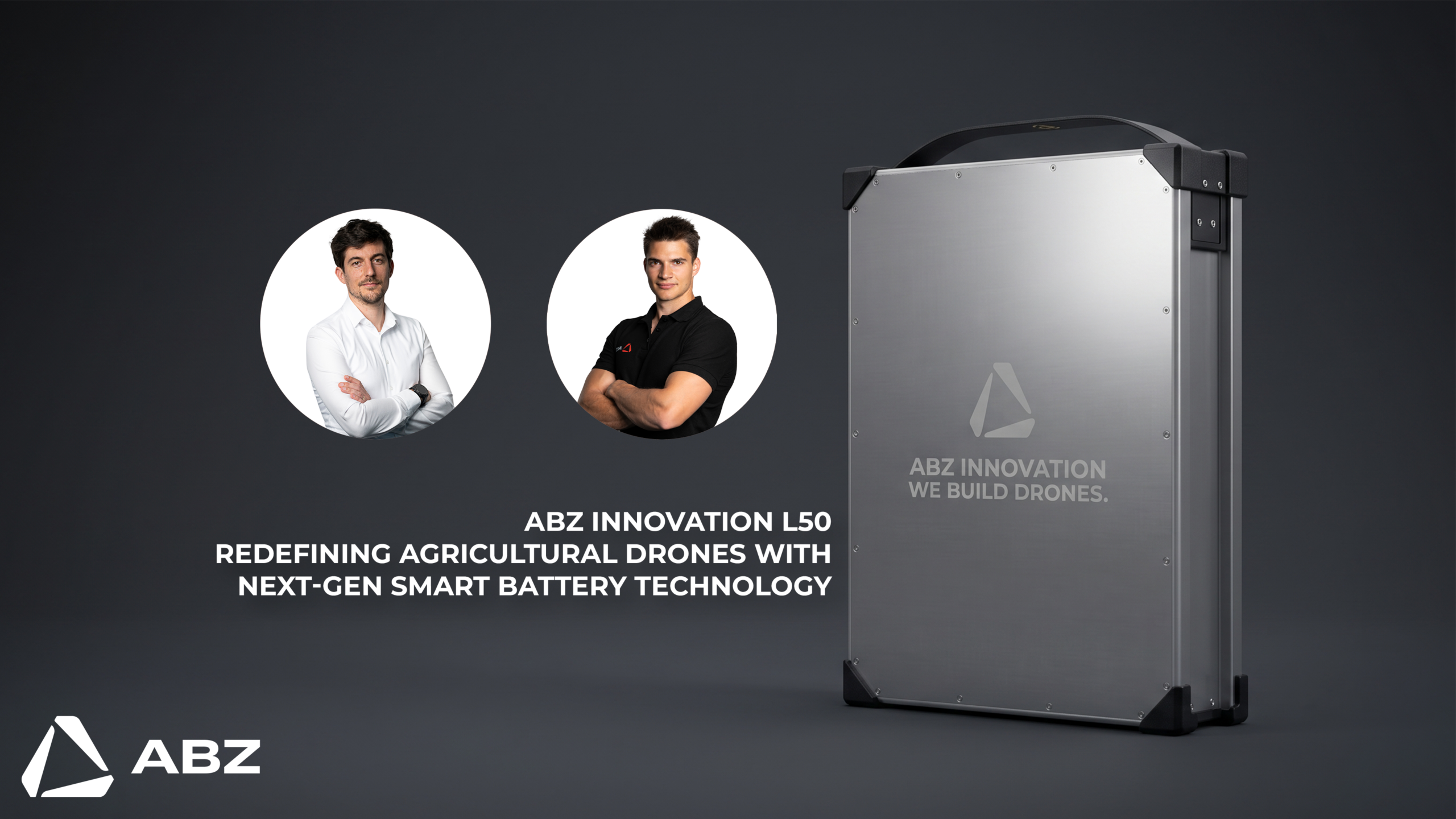
A large tank does not automatically mean a longer flight. In agricultural spraying drones, tank size and battery capacity have to be engineered together — and until now, most large-tank drones have run into the same limitation: the battery empties before the tank does.
ABZ Innovation’s L50 was built to close that gap. In a new webinar, CEO and co-founder Károly Ludvigh sits down with Zsombor Vejtey, Head of RnD and one of ABZ’s most experienced test pilots, to walk through the engineering behind the L50’s battery — and what it means for operators in the field.
The problem with oversized tanks
Most spraying drones on the market still rely on older lithium-polymer battery chemistry. Pair that with a large tank and a low application rate — the kind used for cereal crops, at 10 to 15 litres per hectare — and the battery reaches its limit long before the tank does. The result: a drone that is marketed on tank size but, in practice, operates like a smaller one.
The L50 addresses this directly with a newly designed, cylindrical-cell battery, engineered in-house for significantly higher capacity than anything else in its class. The difference is immediate: with a full tank, the L50 can remain airborne for 10 to 15 minutes; with an empty tank, more than 15 minutes. In practical terms, it can cover up to 4.1 hectares — around 7.5 acres — in a single flight, at low-volume application rates that would ground most drones in its size category well before the tank runs dry.
What it means for a working day
In the webinar, Zsombor Vejtey shares field examples from real operations, including missions where the drone had to travel 600 metres from the base station before spraying could even begin. On a smaller drone, that outbound distance alone could consume most of the battery. On the L50, the same mission covers three or more hectares and still returns with 20 to 25 percent charge remaining.
That reserve matters beyond a single flight. Operators working large or irregular fields can keep a single base station position for longer, rather than relocating every time the spraying route moves out of range — a change of position that can otherwise cost up to 30 minutes of working time.
Built to run cooler, for longer
The new cell chemistry also carries a lower internal resistance, which means the battery generates significantly less heat during continuous operation — removing the need for the heavy active cooling that older battery packs require, even in ambient temperatures of 35 to 40°C. In testing, the pack stayed within a safe operating range without additional airflow or water cooling, and was ready to return to the charger immediately after landing, supporting continuous multi-battery missions throughout the day.
Every battery also connects to the operator’s phone, reporting real-time status, cycle history, and firmware updates remotely — giving pilots visibility into cell temperature and battery health without ever needing to plug in a diagnostic cable.
“One example: the L50 can cover 4 to 4.1 hectares in a single flight. The second-best drone on the market, with a 100-litre tank, can do 2.5 to 2.6. That’s the true trick behind the new battery.”
— Károly Ludvigh, CEO & Co-founder, ABZ Innovation
The full conversation between Károly Ludvigh and Zsombor Vejtey — covering battery chemistry, real-world flight examples, and remote diagnostics — is now available on the ABZ Innovation YouTube channel.
About the L50
The L50 is ABZ Innovation’s 50-litre agricultural spraying drone, built for large-scale operations that require both tank capacity and flight endurance. It is part of ABZ’s broader drone portfolio, manufactured at the company’s Szentendre facility and supported across 40+ countries through ABZ’s global distributor and after-sales network.


