
Dense Canopy, Steep Slopes: Proving ABZ Innovation L50 Spraying Efficiency in Sunflowers
One of the key challenges in modern field crop management is ensuring effective, uniform plant protection in tall, dense crops while maintaining high operational efficiency. In its recent field trial in Tarján, ABZ Innovation evaluated the coverage, droplet distribution, and canopy penetration of drone spraying in a closed sunflower field using water-sensitive papers. The test was conducted on a hilly slope area provided by Izeli Kft., designed to test the terrain-following stability and application precision of the drone technology under challenging topography.
Flight and Spraying Parameters
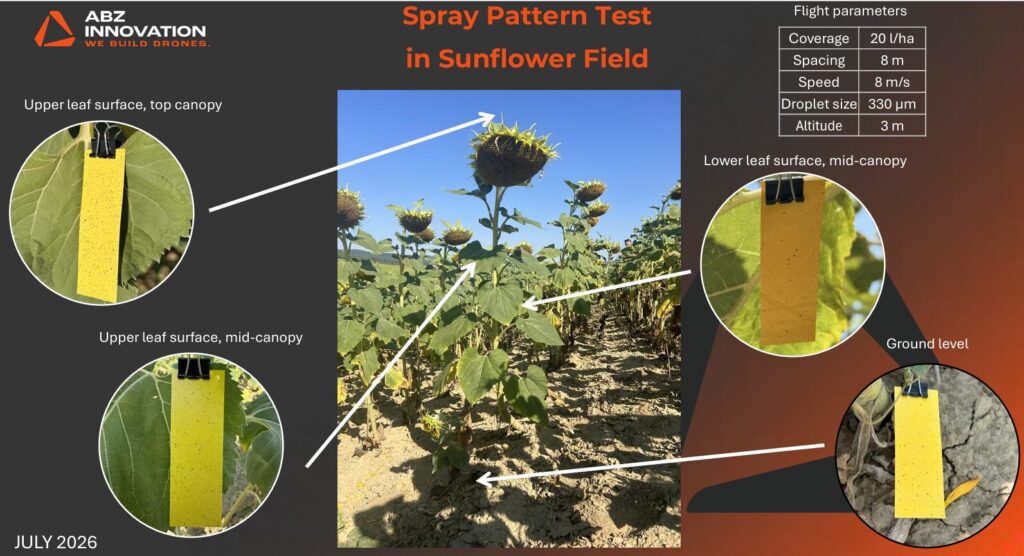
The spray pattern test was conducted using the ABZ Innovation L50 spraying drone system. The parameters applied during the trial were designed to maintain an optimal balance between aerial application efficiency and the target droplet size range, specifically in ultra-low volume (ULV) mode.
During the testing process, the drone application was intentionally carried out using water only, deliberately stressing the system to evaluate the spray pattern under extreme operational conditions. It is important to emphasize that in field practice—when applying plant protection products, biostimulants, or foliar fertilizers together with suitable adjuvants—spray drift is significantly reduced due to altered droplet formation. Under real operational conditions, this results in a further improvement of both spray pattern and coverage.

Résultats
To evaluate the penetration capability of the spray liquid through the tall sunflower canopy, water-sensitive test papers were attached at multiple heights and orientations, including the upper and lower leaf surfaces, mid-canopy zones, and ground level.
- 1. Upper Leaf Surface (Top Canopy): Extremely dense and uniform droplet deposition was observed across the topmost leaves and flower heads. Droplet coverage reached near-total surface saturation (~95–100%).
- 2. Upper Leaf Surface (Mid-Canopy): Strong and uniform droplet distribution (~70–80% coverage). The droplets penetrated the dense upper leaf layers effectively, ensuring strong protection in the middle canopy.
- 3. Lower Leaf Surface (Mid-Canopy / Abaxial): Clear, visible droplet deposits (~30–40% coverage) were recorded on the lower side of the leaves. This confirms that the strong downwash airflow produced by the drone rotors effectively turbulence-rotates leaves to coat abaxial surfaces.
- 4. Ground Level: evenly distributed droplet marks (~25–35% coverage) were detected at soil level. This proves full-depth vertical penetration throughout the entire height of the sunflower stand.

Proven Efficiency on Complex Terrain
The field trial in Tarján conclusively proves that drone technology is the optimal solution for managing tall, dense crops on sloped topography. Where heavy ground machinery faces severe operational risks—such as wheel slippage, soil erosion, and uneven speeds on inclines—the ABZ Innovation L50 system demonstrated that consistent, high-density canopy penetration is fully achievable regardless of terrain complexity.
Key Takeaways
Even under worst-case stress conditions—using pure water only (no additives or surfactants) on steep, rolling slopes—the ABZ L50 delivered outstanding results. Achieving full top-to-bottom canopy coverage under these challenging constraints proves that real-world applications with proper tank mixes will perform flawlessly.
- Exceptional Canopy Penetration: Powerful rotor downwash successfully drove pure water droplets deep into the dense foliage, achieving up to 100% top coverage and coating even the lower leaf surfaces (30–40%).
- Flawless Terrain Adaptation: Automated altitude sensors navigated steep inclines with total precision, maintaining consistent delivery while completely eliminating soil compaction, track erosion, and crop damage.
- Zero Ground Damage: Flawless slope tracking replaces heavy ground machinery—completely eliminating soil compaction, track erosion, and crop crushing.
- Cost & Operational Efficiency: Enables targeted hotspot spraying to cut input costs, plus 24/7 night-flying flexibility to eliminate heat evaporation.
- Safe & Future-Proof: Guarantees 100% operator safety while offering complete application versatility for pesticides, biostimulants, and foliar fertilizers.




IMPORTANT NOTICE:
This experiment serves strictly as a baseline. In practical commercial applications, spraying configurations, flow rates, and other flight parameters must always be adjusted dynamically to adapt to specific crop vegetation and field layouts, microclimates, and ambient environmental conditions.
Unauthorized reproduction or plagiarism of this work is strictly prohibited. Proper citation is required for any use of its content.


