Spray Pattern Guide to Drone Application
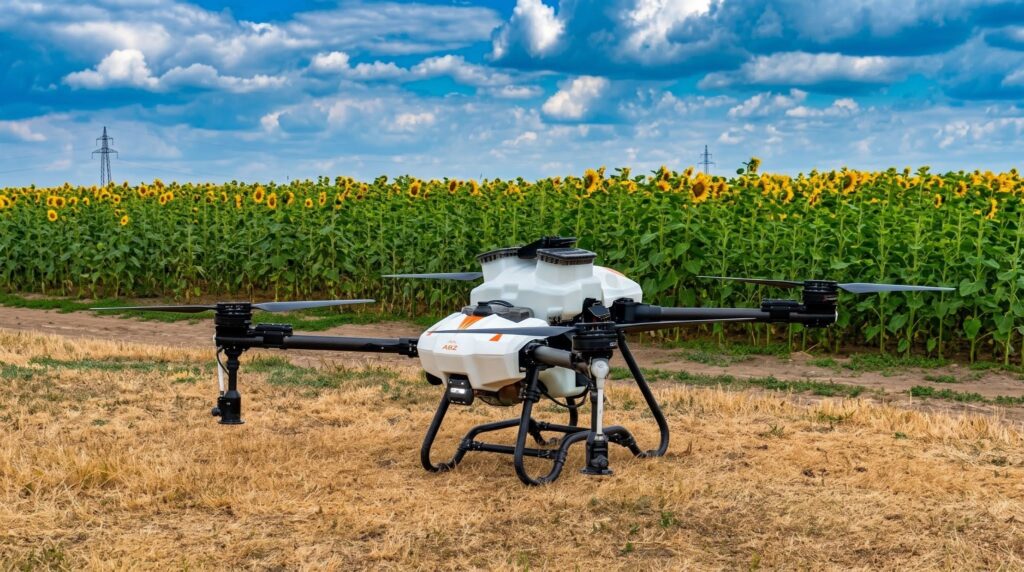
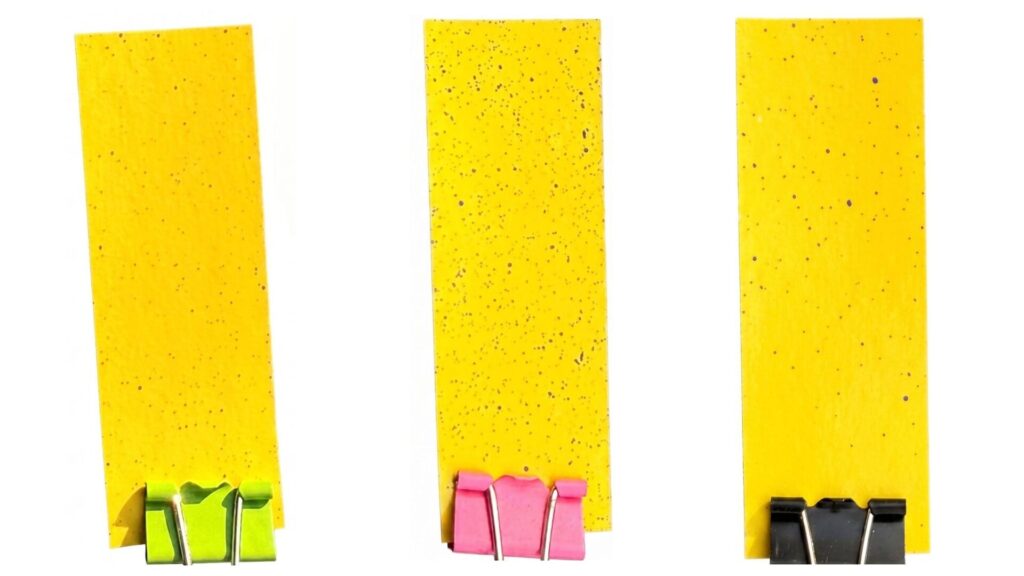
The spray patterns analyzed on water-sensitive test papers reflect the most critical indicators of precision agricultural application. For modern agricultural spraying drones like the ABZ Innovation L50, droplet density and biological efficacy are determined by the application volume, flight dynamics, and rotary disc CDA (Controlled Droplet Application) settings.
Below is a detailed analysis of the tested spray patterns based on coverage degree and biological efficacy.
Excellent and dense spray pattern
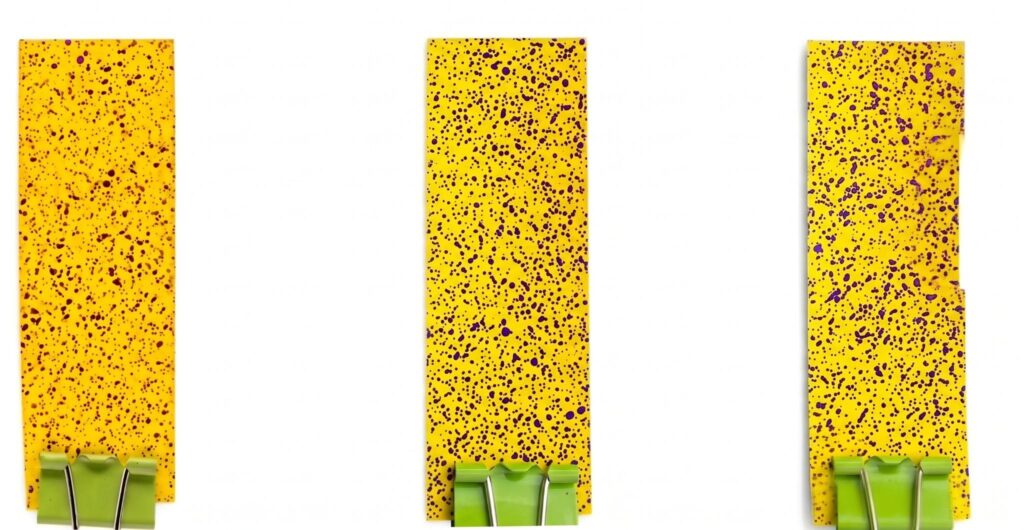
This category represents exceptionally high droplet density and highly uniform coverage. It is the ideal setting for contact pesticides, guaranteeing that no unprotected micro-zones remain on the plant surface. This pattern performs best in dense, high-canopy crop stands. Drone application offers a major advantage here: the downward airflow (downwash) generated by the rotors forces the dense droplet volume deep into the canopy, reaching the undersides of leaves without causing trampling damage to the crop.
Good and optimal spray pattern
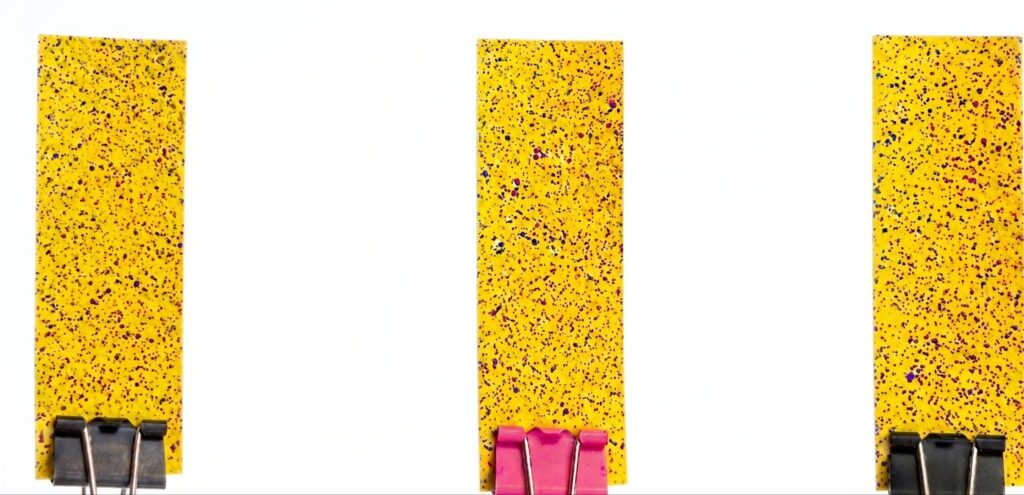
This category represents the ideal balance between droplet density and application economy. Droplet distribution is fine, distinct, and uniform across the target surface. It is optimal for systemic crop protection products, foliar fertilizers, plant growth regulators (PGRs), and desiccation operations—applications where 100% physical surface coverage is not strictly required because active ingredients enter and translocate through the plant’s vascular system.
Medium spray pattern
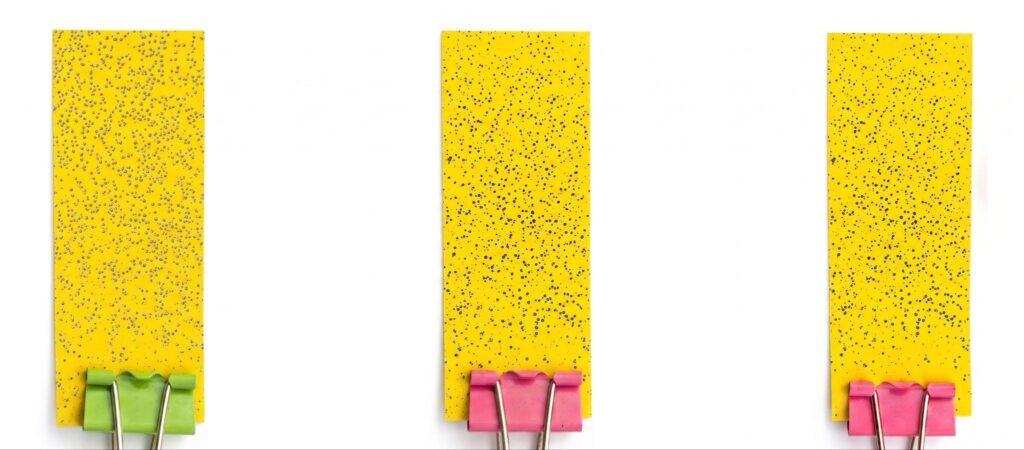
In this category, droplet density is noticeably lower, leaving small unsprayed gaps. This level is not considered reliable for most standard treatments, as pathogens or pests can easily escape active ingredients in uncovered zones. It is explicitly not recommended for contact products and remains risky for systemic active ingredients. It should only be considered for specialized scenarios, such as applying systemic herbicides on flat, open terrain (e.g., stubble treatment) or in sparse, young crop stands. Operators are advised to achieve better coverage by fine-tuning the drone’s CDA system, such as increasing liquid volume or pressure.
Low-Density Spray Pattern
This pattern features a drastically low droplet count with massive uncovered areas. It is unsuitable for both contact and systemic products, as it allows pathogens or insects to survive practically unscathed, leading to the development of resistance and severe yield loss. It is only acceptable in rare, specialized cases, such as liquid fertilizer application with coarse droplets where target deposition on the soil is the objective, or for localized weed spot treatments. In all other scenarios, significant adjustment of the settings is required.
Technology Highlights of the ABZ Innovation L Series
ABZ Innovation’s L Series drones (such as the L50 model) represent the forefront of modern precision agriculture. With a 50-liter tank capacity and integrated CDA system software, operators can infinitely adjust droplet size from fine mist to coarse droplets to precisely configure all spray pattern requirements.
Combined with an outstanding field capacity of up to 24 hectares per hour and a closed network architecture for data security, the system provides a cost-effective, weather-independent alternative to traditional machinery application in both field crops and orchards.