
Performance Test: Flight Time and Payload Capacity of the ABZ Innovation M12
Purpose of the Test
The ABZ Innovation M12 is an EU Open category (C4 certified), multipurpose industrial drone. The unit’s total weight including the battery is only 15.8 kg (11.6 kg without battery), while its maximum take-off weight (MTOW) is 24.9 kg. This allows for an official payload capacity of 9.1 kg (without the LiDAR option), which is made exceptionally versatile for industrial R&D, data collection, and sensor integration tasks by the platform’s universal power supply (5V, 12V, battery voltage) and communication interfaces (UART, I2C, CAN, USB, PWM, GPIO).
The objective of the test series was to assess how varying payload weights (0–10 kg) and environmental factors (wind speed, temperature, humidity) affect the practical discharge rate of the aircraft’s 16,000 mAh (44.4V) Li-Po Smart battery and the power consumption of the rotors.
Test Data and Conditions
The testing was conducted over five consecutive flights. The drone has a maximum wind tolerance of 10 m/s and a maximum operating flight speed of 15 m/s (54 km/h); during the tests, the wind speed remained within the safe range of 1.8–4.2 m/s:
| Flight # | Temperature (°C) | Wind velocity (m/s) | Humidity (%) | Load / Payload (kg) | Flight time |
|---|---|---|---|---|---|
| #1. flight | 21,9 °C | 4,2 m/s | 39,3 % | 10,00 kg (Exceeding the max. load capacity) | 9,00 min. |
| #2. flight | 18,4 °C | 1,8 m/s | 47,9 % | 5,00 kg (Moderate load) | 12,26 min. |
| #3. flight | 20,3 °C | 1,8 m/s | 43,2 % | 0 kg | 20,25 min. |
| #4. flight | 26,8 °C | 2,5 m/s | 30,3 % | 0 kg | 21,28 min. |
| #5. flight | 27,4 °C | 4,2 m/s | 28,8 % | 0 kg | 22,00 min. |
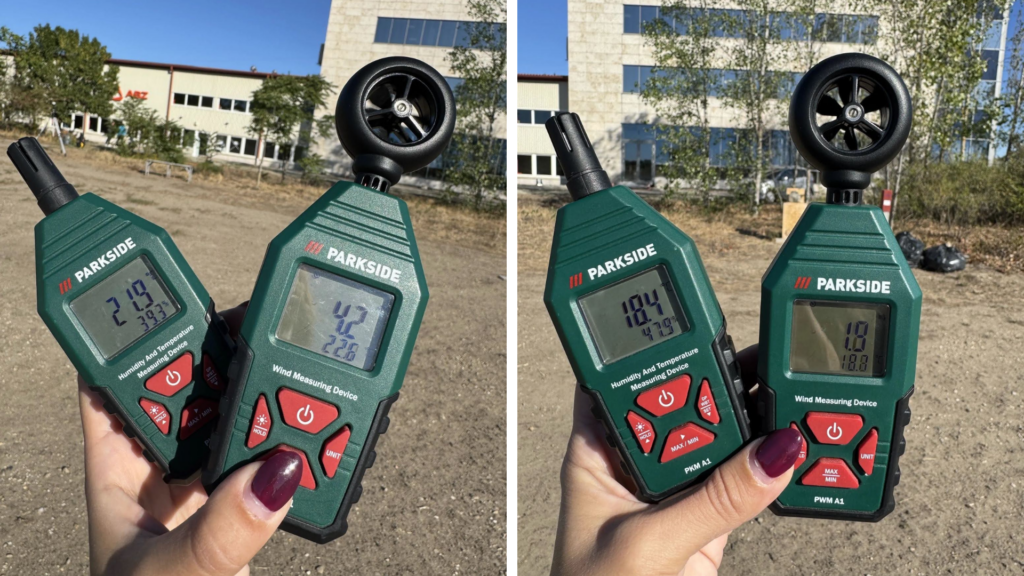
To ensure reliable data collection during the test series, local meteorological conditions were continuously monitored using digital handheld measuring instruments. Measurements were recorded directly at the take-off area immediately prior to flights, ensuring the accuracy of the measured parameters.
Key Findings and Technical Analysis
1. Correlation Between Rotor Load and Flight Time
- Maximum Load (10 kg): The M12 factory specification designates a 9.1 kg payload as its maximum capacity. Carrying the 10 kg load applied in Test 1, the aircraft remained fully stable in the air while operating at the upper boundary of the C4 category. In 4.2 m/s winds, the 30×11 size rotors and propulsion system delivered a flight time of 9.00 minutes.
- Medium Load (5 kg): During Flight 2, using a 5 kg payload increased the flight time to 12.26 minutes (+36% compared to full load). This value approaches the standard 15–26 minute flight time range listed in the factory specifications; the slight deviation is likely attributable to adverse weather conditions—such as the lower ambient temperature of 18.4 °C and wind conditions—as well as flying under continuous load. The measurement demonstrates that even under cooler, more demanding field conditions, the aircraft provides a predictable operational flight window exceeding 12 minutes.
2. Battery Performance and Environmental Effects
- Base Configuration (0 kg Payload): Without instruments, the M12 achieved a flight time of 20–22 minutes. This aligns with the standard 15–26 minute flight time listed on the factory datasheet.
- Fast Charging and Efficiency: The M12’s 3000 W fast charger can recharge the 16,000 mAh battery in a minimum of 11 minutes. This means that for operations with 0 kg or light payloads, near-continuous, uninterrupted field operations can be maintained using a rotation of 2–3 batteries.
- Impact of Temperature: At ambient temperatures above 25 °C (Tests 4 and 5), the internal resistance of the battery cells was lower, allowing the drone to reach a peak flight time of 22 minutes even in 4.2 m/s winds.
Practical Applications on the M12 Platform
Based on the interface options listed in the factory datasheet (e.g., UART, CAN, I2C, GPIO) and the measured flight times, the M12 is ideally suited for the following application profiles.
- Complex Sensor Carrying (3–5 kg Payload):
- Expected Flight Time: 12–15 minutes
- Practical Example: Simultaneous integration of high-resolution LiDAR systems (optional), multispectral cameras (optional), and RTK correction modules, taking advantage of the aircraft’s ±10 cm RTK hovering accuracy.
- Heavy Instruments and Transport (8–10 kg Payload):
- Expected Flight Time: 8–10 minutes
- Practical Example: Emergency medical or logistical sample transport, short-duration flight testing of heavy monitoring equipment, or custom R&D prototypes.
- Research & Development and Autonomous Testing (0–2 kg Payload):
- Expected Flight Time: 20–22 minutes
- Practical Example: University and industrial development, open-source algorithm testing within the 3.5 km remote control range.
Zusammenfassung
The performance test of the ABZ Innovation M12 confirmed that the platform delivers its specified key metrics under real-world operational conditions. Based on the measurement data, the aircraft responds to payload changes with predictable energy consumption and stable flight characteristics, which is an essential prerequisite for accurate industrial data collection and safe mission execution.
A primary technological advantage of the system is its integrated Dual-RTK-based heading and positioning system, which drastically reduces compass interference during flights near industrial infrastructure (e.g., high-voltage power lines, metal warehouses), guaranteeing millimeter-level repeatability. This is complemented by a compact, foldable frame structure (770540600mm when folded), enabling exceptionally easy mobility and single-operator field logistics relative to its 9.1 kg (without LiDAR) payload capacity.
Direct European manufacturing and engineering support, factory-assured C4 EU compliance, and standardized connection interfaces create a predictable operating environment that allows industrial operators to minimize service downtime and international supply chain risks.


