
More Than a Spraying Drone: Greenhouse cleaning with the L30 V2
Along with shading greenhouses and polytunnels, the timely removal of the seasonal shading layer is also a crucial step: allowing adequate light transmission directly affects the climate of growing facilities and plant development. However, applying the Removit shade remover using traditional methods posed a serious physical challenge and safety risk.
Previously, this process was carried out with backpack sprayers or specialized boom tractors for smaller single-bay/tunnel polytunnels, while multi-bay gutter-connected polytunnels and greenhouses required manual spray carts pushed along the drainage gutters. This was not only time-consuming and hard physical labor, but it also presented an accident hazard and exposed workers to chemical vapors. Furthermore, the cart routinely missed the front sections of the tunnels, leaving incomplete cleaning agent coverage.
ABZ Innovation’s Hungarian-developed agricultural drone technology provided a practical and safe solution to this challenge. Following the operation, the client specifically emphasized that they were extremely satisfied with the efficiency of the drone application and the even coverage across the entire surface.
Precision Application with Centimeter-Level Accuracy
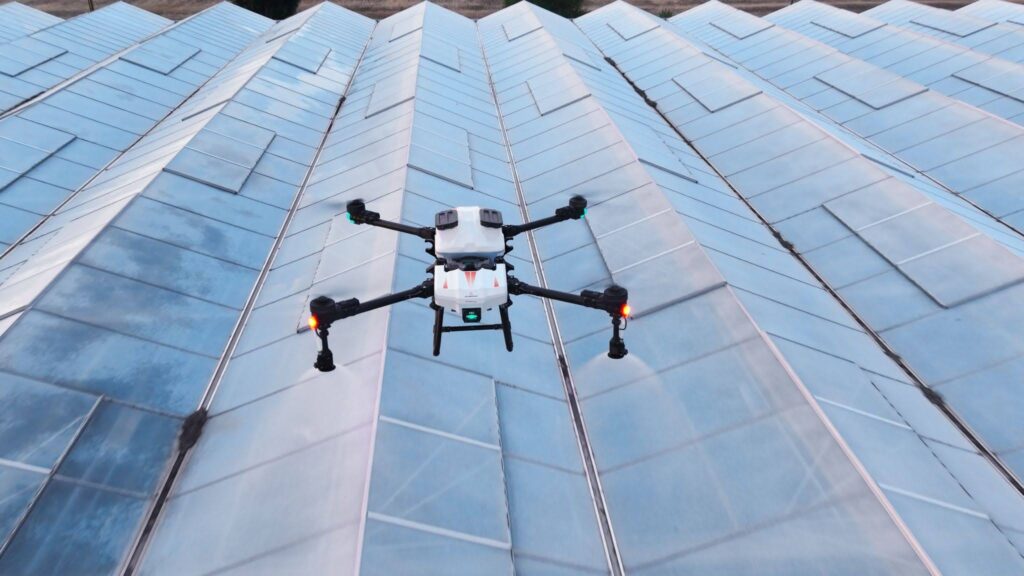
We carried out the operation using the ABZ Innovation L30 spraying drone, guided by Network RTK correction provided by the service provider to ensure precise trajectory tracking. The task was to cover a 1.2-hectare multi-bay greenhouse with a peak height of approximately 6 meters using a Removit solution.
- Stable Flight: We flew parallel to the bays with a minimal offset at an altitude of 9 meters (approx. 3 meters above the ridge).
- Targeted Application: The rotary atomizer (CDA) droplet-forming system sprayed the product onto the ridge of the roof, from where it ran down evenly across the entire surface.
- Operating Parameters: We flew at a flight speed of 5.5 m/s with near-maximum flow rate.
According to Removit’s manufacturer specifications, cleaning 1 hectare requires 250 liters of remover agent mixed with 1,750 liters of water (a total volume of 2,000 l/ha). With drone technology, however, we worked with significantly less liquid: a total of 50 liters of active ingredient was applied in a 260-liter total spray volume across two passes (approx. 105 l/ha dose per pass).
Despite the rising airflow, the adjustable droplet size (397 microns in the first pass and 465 microns in the second) prevented drift: the first application thoroughly soaked the paint, while the second provided full surface coverage for effective breakdown and dissolution.
Work Organization and Results Achieved
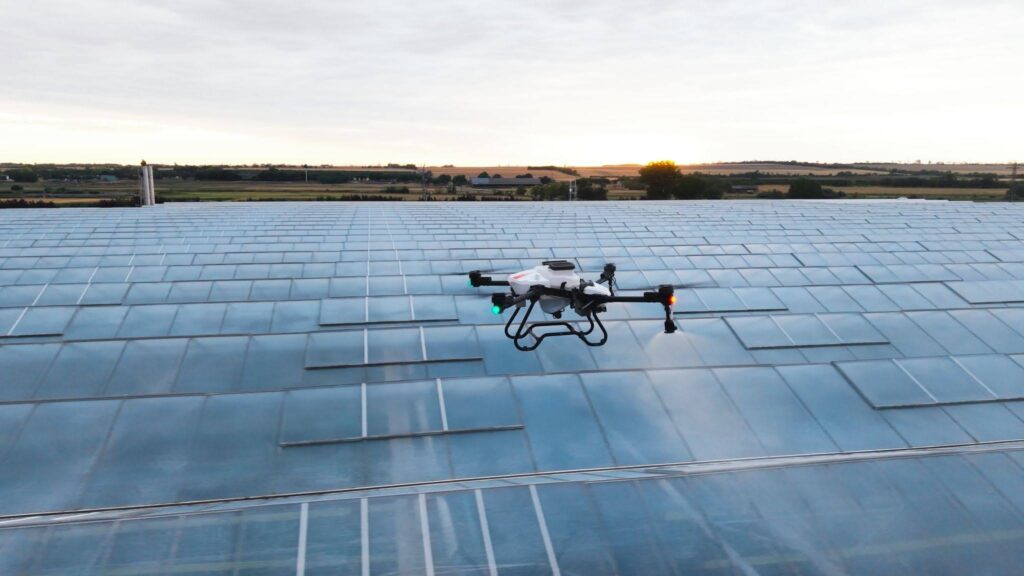
The application began at 6:00 AM, and we completed the entire 1.2-hectare area in just 1.5 hours.
Due to product foaming, the tank was not filled to capacity, resulting in 5 flights per treatment pass. Only one crucial logistical requirement had to be followed: the greenhouse vents had to be completely closed during spraying. Additionally, to minimize ground risk, no personnel were allowed inside the greenhouse while the drone operation was underway.
Why the ABZ Innovation Drone Proved Successful
Based on client feedback, the ABZ Innovation L30 spraying drone represented a clear step forward compared to previous methods:
- Improved Efficiency and Even Soaking: The key to client satisfaction was operational efficiency. Thanks to the homogeneous coverage achieved with CDA technology, Removit delivered outstanding coverage across every point of the roof.
- Enhanced Occupational Safety: Workers were no longer exposed to physical hazards; strenuous work at heights and direct chemical exposure were eliminated.
- Practical Time Savings: A previously hazardous and slow operation was streamlined into a 1.5-hour drone flight.
ABZ Innovation’s agricultural drones are not only suitable for shading agent application and crop protection, but also make greenhouse cleaning and maintenance operations more predictable and significantly safer.

IMPORTANT NOTICE: This experiment serves strictly as a baseline. In practical commercial applications, spraying configurations, flow rates, and other flight parameters must always be adjusted dynamically to adapt to specific greenhouse structures, roof layouts, microclimates, and ambient environmental conditions.
Unauthorized reproduction or plagiarism of this work is strictly prohibited. Proper citation is required for any use of its content.


