
Silent Threats in Arable Crops: Understanding Fusarium, Aflatoxins, and the Need for Targeted Defense
Mycotoxins represent one of the most critical challenges facing modern agriculture and food chain safety. Driven by climate change, extreme weather events—such as excessive precipitation during anthesis or prolonged summer droughts—exacerbate the spread of fungal infections and the production of toxins in our primary arable crops: wheat and maize. Furthermore, the consumption of crops and food products contaminated with mycotoxins can cause severe health damage; therefore, managing and mitigating these risks is of fundamental importance.
Although mycotoxins are often treated merely as an agricultural issue, history and modern medicine demonstrate their terrifying impact: aflatoxin produced by Aspergillus caused the most severe documented mycotoxin poisoning in history in Kenya, leading to the deaths of over a hundred people due to the consumption of contaminated maize. Furthermore, T-2 toxin produced by Fusarium was utilized as a biological weapon (known as “Yellow Rain”) during the Cold War owing to its extremely destructive power. As these fungi and their toxins can cause fatal organ failure, malignant tumors, or deadly lung infections, combating them is not only an economic necessity but a life-saving mission. In this defense, targeted drone application becomes crucial, enabling immediate intervention directly at the infection hotspots—even in hard-to-access, waterlogged, or tall crops—thereby preventing deadly toxins from entering the food chain.
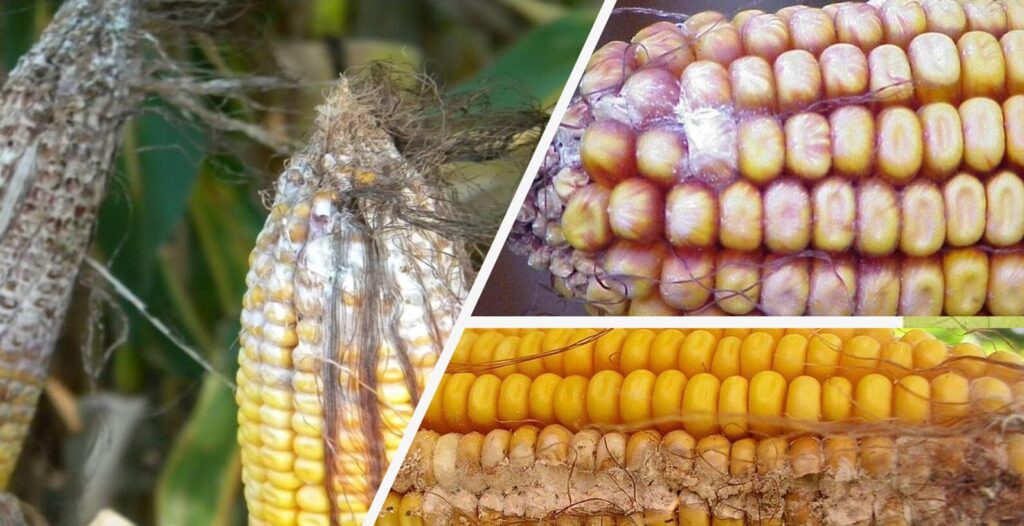
In addition to visual ear rot, an accompanying symptom of Fusarium infection in standing maize crops can be kernel germination prior to harvest.
Major Mycotoxin Infections in Wheat and Maize
- Fusariosis (Fusarium species)
- In wheat (Fusarium head blight): During wet anthesis (flowering), spikelets bleach and kernels become shriveled.
- In maize (stalk rot, Fusarium ear rot): Stalks can even break due to the weakening of the nodes. Ear rot appears during kernel development and maturation.
- Primary toxins: DON (gastrointestinal inflammation), ZEA (reproductive disorders), and Fumonisins (kidney and nervous system damage).
- Aflatoxins (Aspergillus species)
- Spreads on maize ears damaged by insects (e.g., European corn borer) during hot, dry summers.
- Aflatoxin B1: A potent carcinogenic and hepatotoxic compound. In the form of Aflatoxin M1, which passes into milk through dairy cow feed, it poses a direct threat to human health.
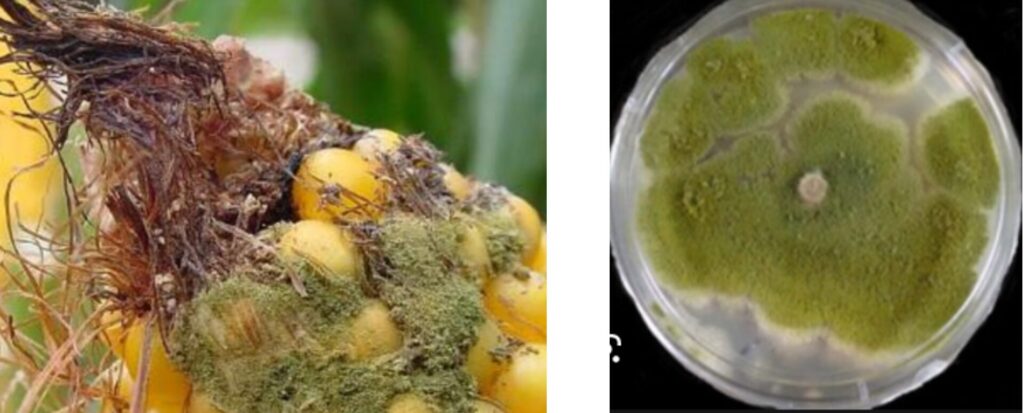
Not only do Aspergillus fungi produce one of the most potent naturally occurring carcinogens in the world (aflatoxin), but inhaling their spores can also cause severe, potentially fatal lung infections (aspergillosis) in both humans and animals.
Mycotoxins are heat-stable and do not decompose during conventional food processing methods.
The Role of Drone Technology in Crop Protection
Targeted Application:
- In wheat: Protection during anthesis can be carried out without soil compaction or crop damage, even on waterlogged fields in rainy weather.
- In maize: In 2–2.5-meter-high crops, the downwash generated by the rotors forces the protective agent beneath the canopy, directly onto the ears.
Biological Control: Precise, spot-application of non-toxigenic Aspergillus strains or biostimulants can prevent infection and mitigate drought stress.
Summary Mycotoxins produced by Fusarium and Aspergillus species not only cause agricultural yield losses, but also pose a direct threat to food safety. Instead of traditional, full-field broadcast applications, drone-based precision crop protection enables farmers to detect risks in real time and intervene precisely where, when, and to the extent necessary. Drone technology plays a prominent role in this process: it allows for the rapid, efficient, and precise treatment of hard-to-access crops, thereby contributing to enhanced food safety.


