
Where Does the Water Go?
The Technological Secret of Drone Spraying
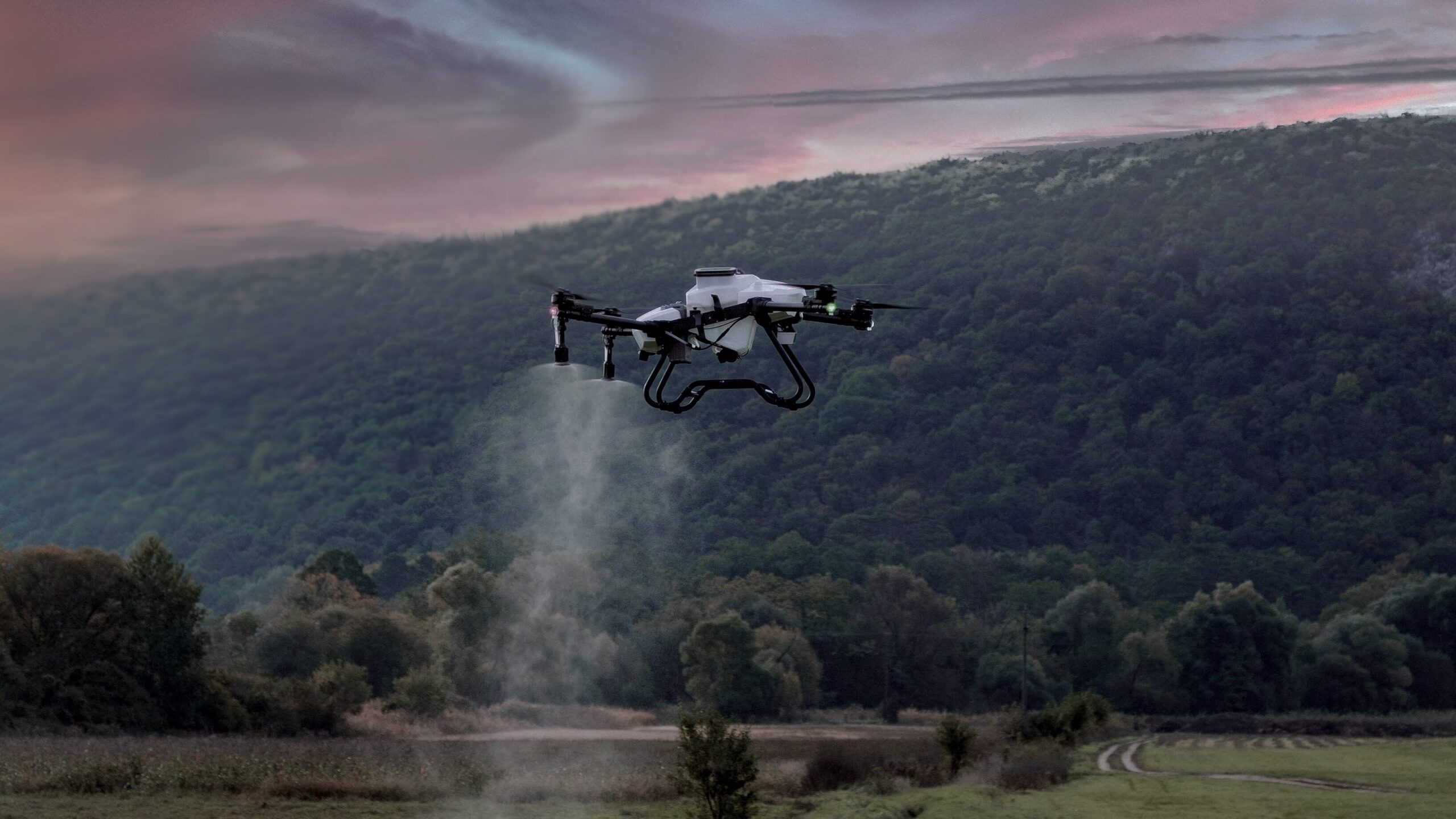
Have you ever wondered how it’s possible that a traditional ground sprayer uses 300, 500, or even in the case of intensive orchards 1000 liters of water to treat a single hectare, while a modern sprayer drone can do the exact same job with just 15 to 40 liters? Does this mean less active ingredients reach the plant, making the protection less effective?
The answer is a definitive no. The secret lies not in magic, but in modern physics, aerodynamics, and precision technology. Let’s explore why this system works with such an incredibly small amount of water!
Water is just the “carrier rocket”
To understand the logic behind drones, we have to ask a fundamental question: What is the actual role of water in spraying? Water is not the medicine itself; it is merely the carrier that transports the active ingredient to the surface of the plant.
With ground machines, the large mass of water provides the gravitational weight that pushes the spray down onto the crop. But what happens in practice? The huge, heavy water droplets easily merge on the leaf and then, due to gravity, simply drip down into the soil. This is a pure loss of expensive active ingredients and a source of environmental pollution.
Micro-droplets and ULV technology
Drones use a completely different approach called ULV (Ultra-Low Volume) technology. Instead of “pouring” water over the plant, they use special, centrifugal nozzles to atomize the concentrated spray mixture into a fine, mist-like cloud of micro-droplets.
Think about it: If we break a single large water droplet into 1,000 tiny micro-droplets, that same volume of water can suddenly cover a much larger surface area evenly! Drones do exactly this: they don’t soak the surface; they delicately “paint” it.
The ultimate weapon: The rotor’s downwash effect
If drones only sprayed mist, even the slightest breeze would blow it away. This is where the drone’s biggest physical advantage comes into play: aerodynamics.
The high-performance rotors keep a machine weighing tens of kilograms in the air, which requires generating a massive downward airflow (known as the downwash effect). When the micro-droplets leave the nozzle, they are caught in this strong, downward-moving, turbulent column of air.
Why is this brilliant for crop protection?
- Canopy penetration: The wind pressure literally opens up and “combs” through the crop canopy, ensuring that the fine spray mist doesn’t just get caught on the top leaves but reaches the lower, hidden layers as well.
- Reaching the underside of leaves: The turbulent airflow gently flips the leaves. As a result, the spray mixture also reaches the underside of the foliage. This is critical because most pests (e.g., mites, aphids) and a significant portion of fungal infections hide exactly there!
The Challenges of ULV: Managing Concentrated Mixtures
While the technology is revolutionary, the drastic reduction in water introduces specific agronomic challenges that must be carefully managed:
- Phytotoxicity: The extreme concentration of active ingredients can easily cause severe leaf burn. Therefore, it is crucial to use higher water volumes when applying the most high-risk preparations: macronutrient foliar fertilizers (due to osmotic shock), contact fungicides (such as copper and sulfur), and solvent-based EC formulations.
- Evaporation & The Need for Adjuvants: ULV micro-droplets evaporate rapidly, leading to wind drift or unabsorbable chemical crystals on the leaf. Therefore, using specialized adjuvants (anti-evaporants, spreaders, and penetrants) is mandatory to stabilize the droplets and ensure proper absorption.
However, if we pay proper attention to these sensitive areas of application, drone spraying is absolutely safe and effective.
Summary: Less water, higher efficiency
When a sprayer drone glides over a hectare with just 20 liters of water, the plants receive the exact same amount of active plant protection ingredients as they would from a 300-liter ground spraying—only much more concentrated, distributed more evenly, and delivered to the most hidden areas thanks to the rotor wash.
The radical reduction in water is therefore not a compromise, but a physical and technological revolution. As an added bonus, it protects the soil from compaction caused by heavy machinery and prevents excess water from washing chemicals into the groundwater.


