
Early Drought Detection and Precision Intervention with Agricultural Drones
During drought conditions, the early symptoms of water stress remain invisible to the naked eye. Crop stands often appear uniformly green and healthy, while significant physiological changes are already taking place beneath the surface. Within the first days of water deficit, chlorophyll activity declines and the leaf mesophyll tissue undergoes microscopic structural changes long before any visible signs of wilting appear.
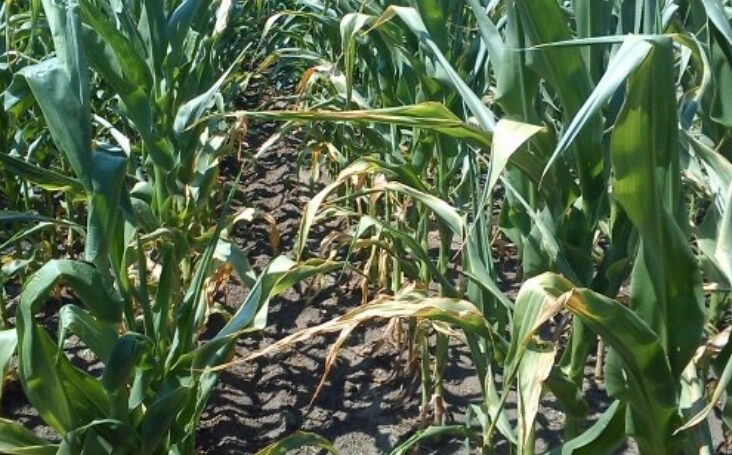
Severe drought symptoms: corn leaf rolling
NDVI: Mapping Early Cellular-Level Changes
The Normalized Difference Vegetation Index (NDVI), calculated from multispectral imagery captured by drones, analyzes vegetation reflectance in the near-infrared (NIR) spectrum to assess the internal cellular structure of leaves. This technology enables the detection of microscopic stress-induced changes at a very early stage, providing growers with a 7–14-day decision-making advantage. This critical biological window allows targeted foliar nutrient or biostimulant applications while the stress response is still reversible, significantly reducing the risk of yield loss.
Thermal Imaging: Identifying Invisible Threats
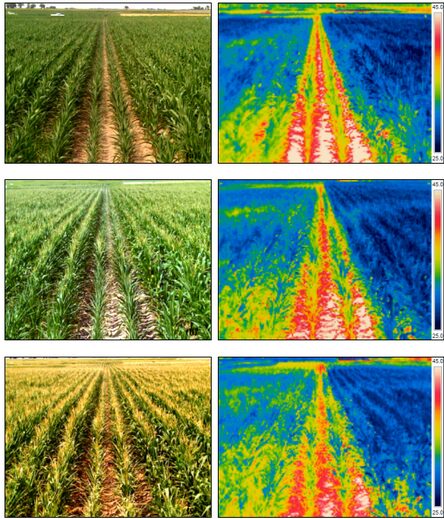
In addition to multispectral imaging, thermal cameras play a vital role in early crop stress detection. Under drought conditions or during the onset of disease, plants respond by closing their stomata to conserve water. As transpiration decreases, the natural evaporative cooling effect is reduced, causing a measurable increase in leaf temperature. These thermal anomalies can be detected well before any visible symptoms such as leaf rolling or wilting develop, enabling timely intervention.
Why Variable-Rate Application Matters During Drought
Water stress is rarely uniform across a field. Rather than applying treatments uniformly, site-specific management is critical for three key reasons:
Soil heterogeneity: Lighter-textured soils or elevated areas lose moisture more rapidly than deeper or heavier soils. As a result, crops growing in these zones experience water stress days or even weeks earlier than those in moisture-retaining areas.
Preventing phytotoxicity: Plants suffering from severe drought stress have significantly reduced metabolic activity. Applying a uniform rate of concentrated foliar fertilizer across the entire field may cause leaf scorch and further damage in these highly stressed areas. Variable-rate drone application allows dosage reductions—or even omission of treatment—in critical zones where crop recovery is unlikely.
Optimized timing and resource efficiency: High-value biostimulants and foliar products are applied only where crops remain within a recoverable physiological stage, avoiding unnecessary input costs on severely damaged areas or on plants that are still unaffected.
Maximum Efficiency and Water Savings with Agricultural Spray Drones
Using prescription maps generated from multispectral and thermal surveys, spray drones perform highly precise, site-specific applications, treating only the affected portions of the field—for example, 40–50% of the total area.
While conventional ground sprayers typically require 200–400 L/ha of carrier water, ultra-low-volume (ULV) drone spraying combined with controlled micro-droplet atomization achieves excellent coverage using only 10–40 L/ha of spray solution. Across a 100-hectare farm, this represents a saving of tens of thousands of liters of water, making drone technology particularly valuable during periods of water scarcity.
Agronomic Advantages: Minimized Dust and Zero-Compaction Crop Protection
During dry spells, heavy tractors kick up massive amounts of dust. This dust coats leaf surfaces, clogs stomata, and binds to applied chemicals, severely limiting their biological efficacy. Drone application drastically reduces dust generation during spraying, ensuring optimal uptake of crop protection products or foliar nutrients. At the same time, it prevents wheel-track damage, eliminates soil compaction caused by heavy machinery, and preserves soil structure throughout the growing season.


